Platform selection
Where should I do this work?
Choose an environment that fits the task, the materials you need, and the access your school provides. For everyday work, try a familiar task across platforms and compare usefulness and ease of use.
NESA Fall Leadership Conference 2026
Shifting AI from a Student Tool to an Educator’s Catalyst
Workshop resources from Dr. Brian Bean. Explore the framework, try the diagnostic, and see examples of what purposeful collaboration with AI can produce.
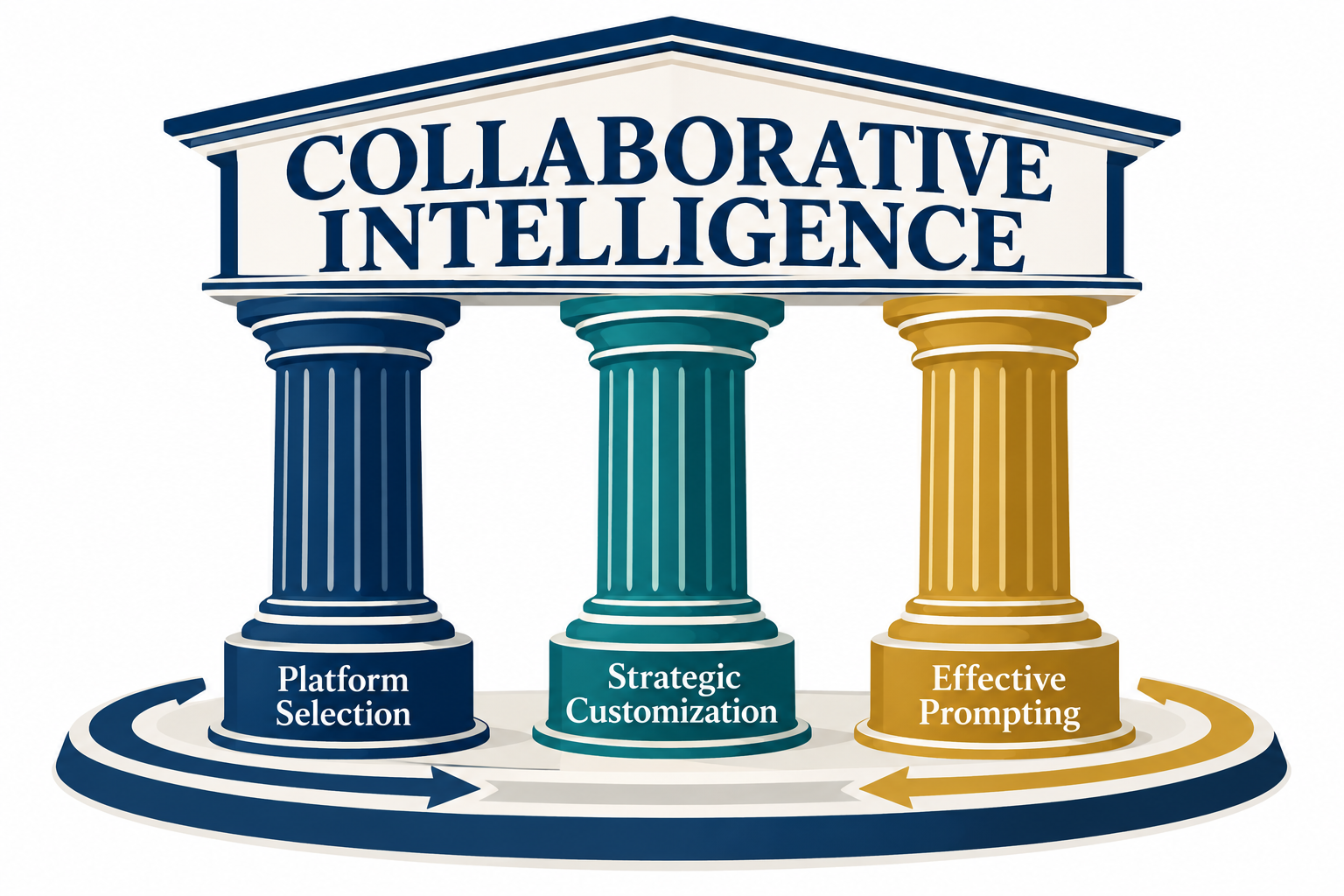
The workshop framework
A framework guides decisions about which tools and processes fit your purpose. Revisit these questions as the work develops.
Where should I do this work?
Choose an environment that fits the task, the materials you need, and the access your school provides. For everyday work, try a familiar task across platforms and compare usefulness and ease of use.
How should AI understand my professional context?
Establish the school priorities, standards, teaching principles, and source documents that should shape its contribution. Make clear what a useful result needs to accomplish.
How should we work through the problem together?
Use dialogue to clarify intent, examine assumptions, and develop the work. Remember the Silver Bullet Prompt. Review the result and continue revising with professional judgment.
“Ask me any clarifying questions necessary to ensure that you are 99% confident you know exactly what I want.”
Use this invitation to begin a conversation. Answer the questions, review the work, and ask for changes. The percentage expresses the desire for a shared understanding; it is not a measured guarantee.
Schoolwide leadership
As the AI Initiatives Lead, I work with a team of teachers, aides, faculty, and staff from each level of our organization. Together, we are developing practical ways to build AI capability while keeping human judgment, student agency, and safety at the center.
“To guide the purposeful, responsible and effective use of Artificial Intelligence (AI) across Casablanca American School, building capability at all levels while advancing teaching practice, student learning and the development of appropriate school policies and procedures.”CAS AI Working Team — Purpose and Goals, 2026–27
Download the CAS AI Committee Purpose and Goals 2026–27 (PDF)
Differentiate professional learning so colleagues can use AI purposefully in planning, assessment, feedback, and everyday work.
Develop age-appropriate AI literacy that supports inquiry and independence without replacing the thinking students need to do.
Build connected policy, literacy, and learning-continuum guidance for responsible use across the school.
Research into practice
Our initial planning drew on IB and UNESCO material covering AI literacy, pedagogy, ethics, assessment, and school policy. Working with my AI agent, we synthesized that research into an internal working reference to help the team weigh options and set priorities.
Download the complete CAS research synthesis (PDF), including its specific connections to our school mandate.
A working example
The CAS AI Profile is a live, formative tool that helps teachers reflect on their practice across five dimensions and identify useful next steps. Working with my AI agent, I helped design the diagnostic and build the application that delivers this school instrument.
Answer from your own teaching experience, or explore a hypothetical teacher profile to consider how differentiated professional learning could work at your school.
This is the existing 20-question diagnostic used with CAS high school teachers. Leaders are invited to explore it as a working example; the questions have not yet been adapted for leadership roles. No email address or account is required. It reports five dimension placements, rather than one overall score, and provides a downloadable PDF. Public answers and results are not saved to a CAS account.Select a dimension for an explanation and example.
Classroom practice
I primarily utilize OpenAI’s ChatGPT and Codex platforms. The projects below all began with a teaching need. While I supplied the classroom context and made the final instructional decisions, engaging in Collaborative Intelligence helped me examine the problems, test ideas, and build responses and tools.
AI and I developed a method for helping IB Business Management students diagnose questions, map their reasoning, and synthesize a response. We studied past IB papers to identify what different questions demand, then tried the method against a wide range of prompts and revised it where it fell short.
A review of 479 past-paper question occurrences and a 48-prompt stress test helped refine the method before classroom use.
I designed the original game with spreadsheets and paper handouts. AI and I turned it into a web app in which student teams run firms, choose a circular business model, and respond to seven changing business conditions.
In my classroom, the administrative gameplay went from roughly two class days to less than one, leaving more time to discuss the decisions and their trade-offs.

Inside the simulation
Each team begins with a circular business model. In every STEEPLE round, a new external pressure changes the situation. Students choose and justify a tactic, then see how that decision affects financial health, market position, and social responsibility in the short and long term. The teacher controls the class pace so each result can become a discussion.
Choose one of the seven rounds above to see the pressure students must respond to.
A classroom problem, solved
During independent IA work, students need one-on-one coaching without interrupting everyone else. This virtual line shows whose turn it is, preserves the order between class sessions, and lets me manage requests on the projector.
AI and I built it around a small, recurring need that many classrooms share.
Interactive example with fictional students. Changes stay in your browser session.A lesson on Gantt charts grew into an IA Planner where students organize tasks, record progress, and produce reports. A second module helps them monitor performance on IB-style assessments.
The tool connects project-management instruction with an ongoing student need: seeing the work ahead and understanding their preparation.
The live student and teacher workspaces require school sign-in.Inside the Tracker
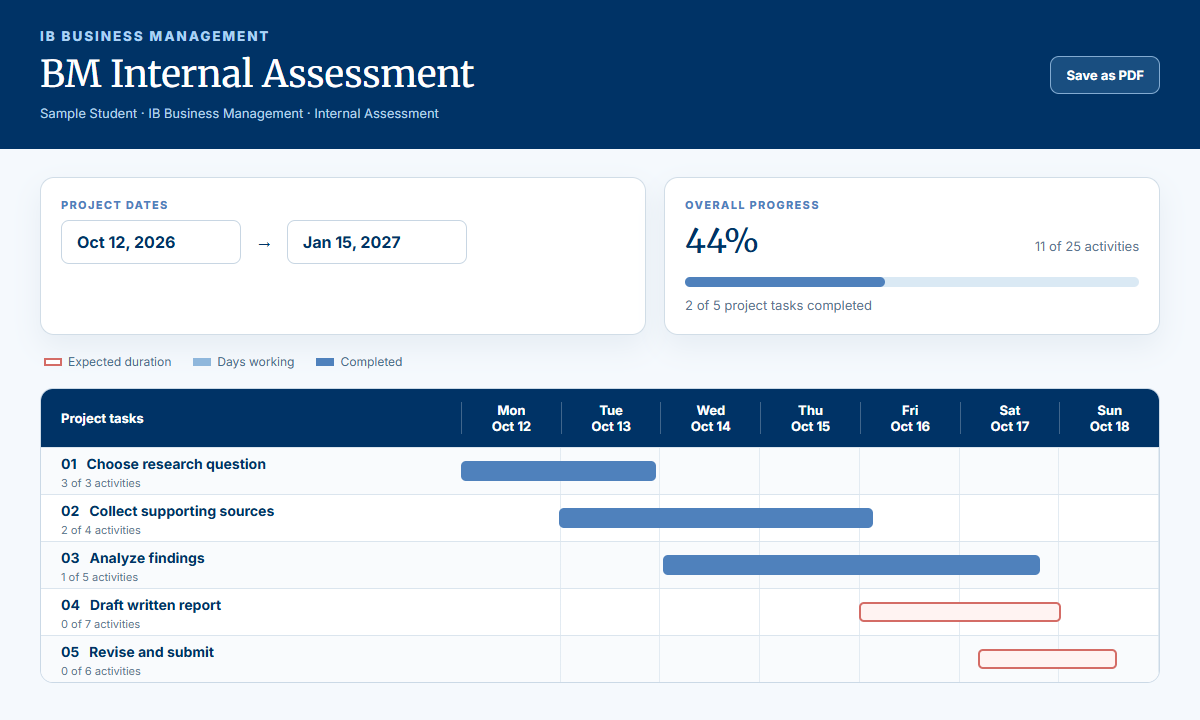
The IA Planner helps students organize their Internal Assessment tasks, set dates, and track progress through the project.
Illustrative recreations based on the application, using fictional data.
Student experience
Classroom Queue · IA Tracker
“The Classroom Queue has been really effective in keeping things organized. Instead of worrying about when it would be my turn to ask questions about my IA, I could focus on my work, prepare my questions, and ask them when my turn came without making the class chaotic. The IA Tracker helped me maintain a steady pace. Whenever I felt lost, it showed me where I was in the process and what I needed to do next, making a large assignment like the IA feel much more manageable.”
Carry the framework into your work
Return to a decision or initiative you are leading. What would someone need to understand about your school to contribute usefully?
Human-centered practice keeps educational judgment and student agency visible. An AI suggestion can be useful, but a teacher must compare it with the student’s work, circumstances, and learning goal before acting.
For example: If a tool recommends a support strategy, the teacher checks the evidence, decides what to try, and later asks whether it actually helped. The decision remains accountable to people, not the tool.
Ethical use means anticipating who could be helped or harmed by an AI-assisted choice. This includes student privacy, bias, accessibility, transparency about AI use, and who is responsible if an output is wrong.
For example: Before sharing student work with a tool, a teacher checks the school’s rules and removes identifying details. They also review the output for unfair assumptions and make its role clear to students.
Knowing how AI tools work at a practical level helps educators choose the right tool for a task and recognize its limits. Fluent output can still be inaccurate, incomplete, or poorly matched to a school context.
For example: A teacher may use AI to propose lesson ideas, then verify any factual claims, inspect the source material, and decide which ideas genuinely serve the lesson.
Pedagogy starts with what students need to learn. AI belongs in an activity only when it improves that learning without doing the thinking students are meant to practice.
For example: Students might critique an AI-generated business recommendation against case evidence, defend a different choice, and reflect on what the tool missed. The teacher looks at their reasoning, not merely the polished output.
Professional learning is an ongoing cycle of trying, checking, revising, and sharing. A new tool is not evidence of better practice by itself; the useful question is what changed for learners or colleagues.
For example: A teacher tests one AI-supported feedback routine, gathers student responses, adjusts it, and shares both the benefit and the limitations with colleagues.
Before writing, students diagnose the prompt using three T’s:
The three T’s help students answer the question that was asked at an appropriate length rather than writing everything they know about a topic.
For developed responses, students build a Claim–Reasoning–Support chain. It is a planning check, not a requirement to write three separate sentences.
In a ten-mark answer, students map several such arguments, compare and weigh them, and organize the logic that leads to a judgment.
A ten-mark answer needs more than a set of good individual points. Students turn their completed Map into a coherent response through four moves:
If the reasoning breaks down while writing, the student returns to the Map and repairs it there.
The pressure: Consumers are asking harder questions about fairness and responsible products while becoming more price-sensitive. Trust is fragile, and the firm must respond without simply passing every cost to customers.
The decision: Which tactic protects credibility and competitiveness, and what trade-off would the team accept in the short term?
The pressure: Digital tools and production technologies promise speed, data, and efficiency, but standards are still emerging. A rushed rollout could disrupt service or reliability.
The decision: Should the firm invest in new capability now, wait, or adapt more selectively? Teams justify the risk and likely longer-term benefit.
The pressure: A recession weakens demand and makes customers more price-sensitive. Competitors are retreating or repositioning, creating both danger and opportunity.
The decision: Students weigh immediate financial resilience against moves that could strengthen the firm when conditions improve.
The pressure: Carbon taxes raise the cost of carbon-intensive operations and supply chains. Firms can absorb the cost, seek a quick workaround, or redesign more deeply.
The decision: Which tactic improves environmental performance without putting the firm’s short-term survival at undue risk?
The pressure: Geopolitical tension and fragmented regulation unsettle supply chains and market access. Responsible practices and innovation may create new routes forward.
The decision: Teams choose how to adapt to uncertainty while considering both current exposure and future positioning.
The pressure: New laws require greater product durability and sustainability. Noncompliance can bring fines or exclusion from important markets, while redesign costs time and money.
The decision: Students must choose a response that preserves market access and explain how the firm will handle the transition.
The pressure: Customers, employees, and regulators expect a firm’s stated values to show up in its actual treatment of people, products, and the environment.
The decision: Teams decide whether their tactic represents a substantive commitment or merely a message, and weigh the cost of credibility over time.