Methods and simulations built around what students need to think through.
Analysis · Instructional design
DMS Design
Tom and I developed a method for helping IB Business Management students diagnose questions, map their reasoning, and synthesize a response. We studied past IB papers to identify what different questions demand, then tried the method against a wide range of prompts and revised it where it fell short.
A review of 479 past-paper question occurrences and a 48-prompt stress test helped refine the method before classroom use.
Simulation · App design
Circular Business Model Simulation
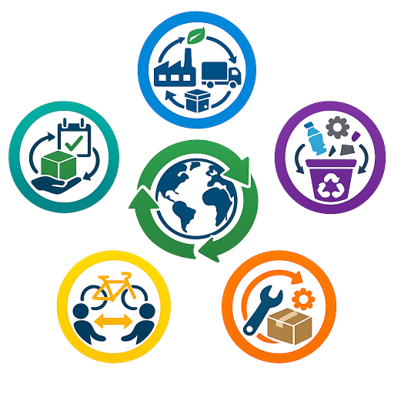
I designed the original game with spreadsheets and paper handouts. AI and I turned it into a web app in which student teams run firms, choose a circular business model, and respond to seven changing business conditions.
In my classroom, the administrative gameplay went from roughly two class days to less than one, leaving more time to discuss the decisions and their trade-offs.
Inside the simulation
Seven rounds. Changing trade-offs.
Each team begins with a circular business model. In every STEEPLE round, a new external pressure changes the situation. Students choose and justify a tactic, then see how that decision affects financial health, market position, and social responsibility in the short and long term. The teacher controls the class pace so each result can become a discussion.
Select a round
Choose one of the seven rounds above to see the pressure students must respond to.
Student experience
In their words
Circular Business Model Simulation
“As a hands-on learner, the CBM simulation helped me understand how circular business models are applied and why companies use them, rather than just what they are. I now find myself recognizing the different models companies use and thinking about why they made those choices. It was very effective.”
Salmane Lahlou · Student
Circular Business Model Simulation
“The CBM Simulation was really fun and helped me better understand how circular business models work. Before, I struggled to understand their purpose and why they are used. The game helped me understand the five types more deeply and how each helps reduce waste. I can now better distinguish between them when taking practice quizzes or looking at case studies. This game was really useful, and I hope we have opportunities to do more in the future.”
Yanis Bouzoubaa · Student
Simulation · Finance and stakeholder decisions
The Pizza Paradox
I rebuilt a promising but cumbersome manual activity as a simulation in which players recruit pizza partners, raise money and negotiate an order. Each partner brings funds and a vote, making the trade-off between financing and control tangible while reinforcing stakeholder interests, compromise and decision-making. The simulation handles the administration so students can focus on the choices.
Take a seat at Tom’s. More partners bring more money—and more voices in the decision.
Human-centered practice keeps educational judgment and student agency visible. An AI suggestion can be useful, but a teacher must compare it with the student’s work, circumstances, and learning goal before acting.
For example: If a tool recommends a support strategy, the teacher checks the evidence, decides what to try, and later asks whether it actually helped. The decision remains accountable to people, not the tool.
Ethical use means anticipating who could be helped or harmed by an AI-assisted choice. This includes student privacy, bias, accessibility, transparency about AI use, and who is responsible if an output is wrong.
For example: Before sharing student work with a tool, a teacher checks the school’s rules and removes identifying details. They also review the output for unfair assumptions and make its role clear to students.
Knowing how AI tools work at a practical level helps educators choose the right tool for a task and recognize its limits. Fluent output can still be inaccurate, incomplete, or poorly matched to a school context.
For example: A teacher may use AI to propose lesson ideas, then verify any factual claims, inspect the source material, and decide which ideas genuinely serve the lesson.
Pedagogy starts with what students need to learn. AI belongs in an activity only when it improves that learning without doing the thinking students are meant to practice.
For example: Students might critique an AI-generated business recommendation against case evidence, defend a different choice, and reflect on what the tool missed. The teacher looks at their reasoning, not merely the polished output.
Professional learning is an ongoing cycle of trying, checking, revising, and sharing. A new tool is not evidence of better practice by itself; the useful question is what changed for learners or colleagues.
For example: A teacher tests one AI-supported feedback routine, gathers student responses, adjusts it, and shares both the benefit and the limitations with colleagues.
Before writing, students diagnose the prompt using three T’s:
Task
What action does the command term require, and how much depth do the marks call for?
Target
What precise result, relationship, decision, or effect must the response address?
Topic
Which business concept and case context give that target meaning?
The three T’s help students answer the question that was asked at an appropriate length rather than writing everything they know about a topic.
For developed responses, students build a Claim–Reasoning–Support chain. It is a planning check, not a requirement to write three separate sentences.
Claim
Answer the diagnosed Target directly.
Reasoning
Explain how or why the claim holds.
Support
Make the reasoning credible with relevant case evidence, data, course knowledge, or another sound basis.
In a ten-mark answer, students map several such arguments, compare and weigh them, and organize the logic that leads to a judgment.
A ten-mark answer needs more than a set of good individual points. Students turn their completed Map into a coherent response through four moves:
Shape
Check that each planned argument can be expressed clearly.
Sequence
Arrange the arguments so their relationships, balance, and relative weight are clear.
Check
Test the planned flow against the Task and markband before drafting.
Write
Produce the introduction, body, and conclusion, ending with a definitive judgment that answers the prompt.
If the reasoning breaks down while writing, the student returns to the Map and repairs it there.
The pressure: Consumers are asking harder questions about fairness and responsible products while becoming more price-sensitive. Trust is fragile, and the firm must respond without simply passing every cost to customers.
The decision: Which tactic protects credibility and competitiveness, and what trade-off would the team accept in the short term?
The pressure: Digital tools and production technologies promise speed, data, and efficiency, but standards are still emerging. A rushed rollout could disrupt service or reliability.
The decision: Should the firm invest in new capability now, wait, or adapt more selectively? Teams justify the risk and likely longer-term benefit.
The pressure: A recession weakens demand and makes customers more price-sensitive. Competitors are retreating or repositioning, creating both danger and opportunity.
The decision: Students weigh immediate financial resilience against moves that could strengthen the firm when conditions improve.
The pressure: Carbon taxes raise the cost of carbon-intensive operations and supply chains. Firms can absorb the cost, seek a quick workaround, or redesign more deeply.
The decision: Which tactic improves environmental performance without putting the firm’s short-term survival at undue risk?
The pressure: Geopolitical tension and fragmented regulation unsettle supply chains and market access. Responsible practices and innovation may create new routes forward.
The decision: Teams choose how to adapt to uncertainty while considering both current exposure and future positioning.
The pressure: New laws require greater product durability and sustainability. Noncompliance can bring fines or exclusion from important markets, while redesign costs time and money.
The decision: Students must choose a response that preserves market access and explain how the firm will handle the transition.
The pressure: Customers, employees, and regulators expect a firm’s stated values to show up in its actual treatment of people, products, and the environment.
The decision: Teams decide whether their tactic represents a substantive commitment or merely a message, and weigh the cost of credibility over time.